
A cleanroom screw with nothing to clean around.
Every slotted, Phillips or hex screw leaves a recess in the surface, and a recess is where contamination waits out the cleaning cycle. The F-Head™ was born in the cleanroom to remove it: the drive is sealed under a plunger, so the head wipes clean in one pass.
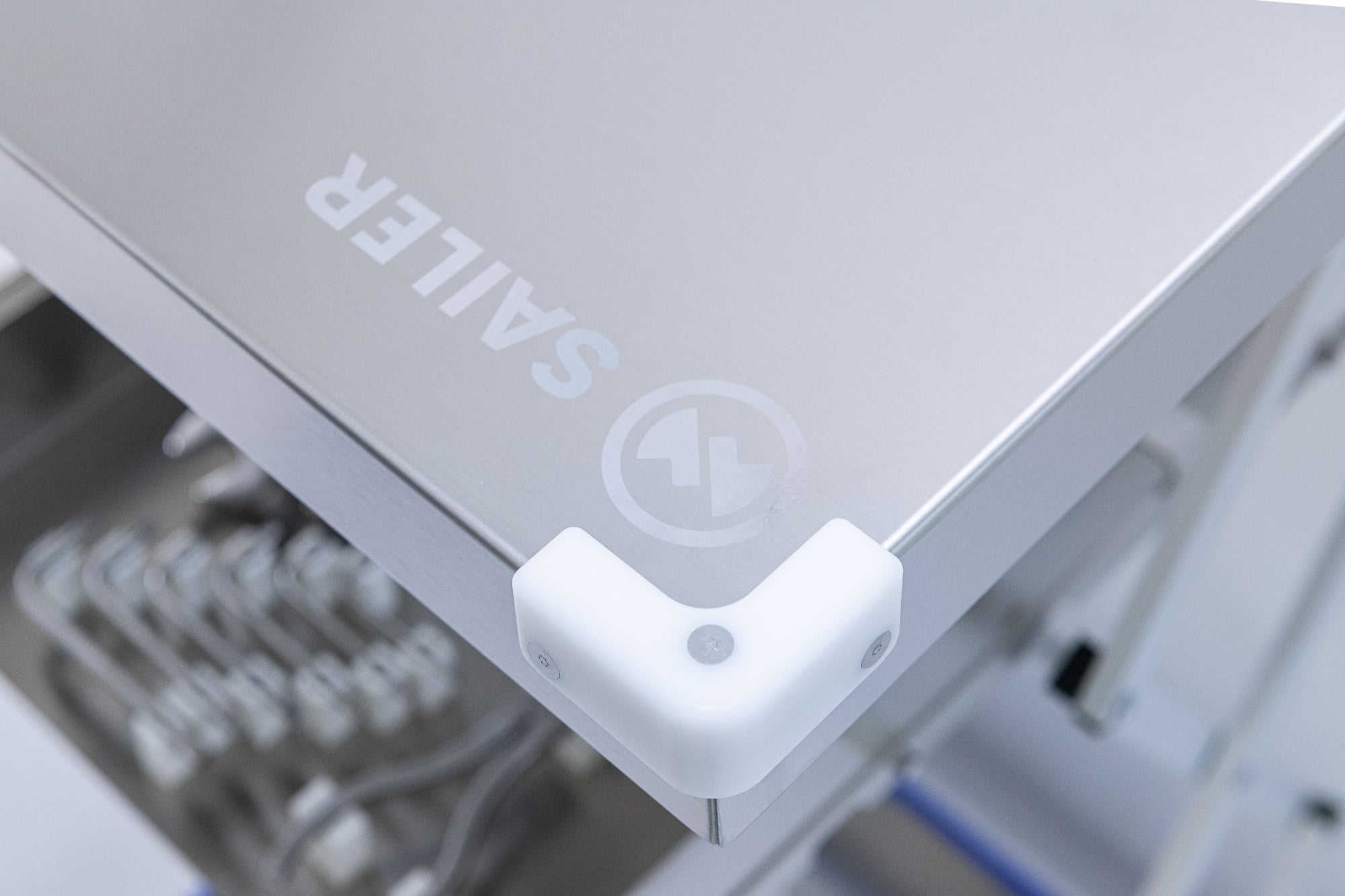
Hygienic design, down to the screw.
Facility teams have tried caulk, caps and plugs to fill screw recesses. They degrade under disinfectants and become a contamination risk of their own. The F-Head™ is the first standard screw to hide its drive, so there is no recess to fill: a closed, level 316 stainless head with less than 6 microns of clearance.
No recess, no crevice
A closed, level head. Nothing for residue, biofilm or cleaning agent to collect in.
Tested against slotted
Our microbiology comparison against standard slotted fasteners is published in full on the Quality & testing page.
316 stainless
Resists aggressive disinfectants and cleaning agents. Brushed finish as standard.
The drive sits inside.
- 01 · Closed
The head is one continuous, level surface. No slot, no socket, nothing to see.
- 02 · Press
A standard 6-lobe bit pushes the captive plunger down and the drive appears.
- 03 · Drive
Install or remove it like any machine screw, with full torque.
- 04 · Release
Lift the bit and the plunger springs back. The surface closes behind it.
One head, every size.
- Head
- Countersunk, flush
- Drive
- Concealed 6-lobe under a captive plunger
- Material
- 316 stainless steel, brushed
- Clearance
- Less than 6 microns
- Metric
- M3, M4, M5, M6 and M8
- Imperial
- #6-32, #8-32, #10-24, #10-32, 1/4-20, 5/16-18 and 3/8-16
- CAD
- Drawing + STEP for every part on the Shop page
Asked plainly.
What makes a fastener hygienic?
Having nothing for contamination to hide in. A standard screw head has an open drive recess; the F-Head™ has none, so the surface can be wiped clean.
How much cleaner is it?
In our microbiology comparison, the F-Head™ retained far less contamination after cleaning than standard slotted fasteners. The method and results are published on the Quality & testing page.
What is it made from?
316 stainless steel, with less than 6 microns of clearance between the plunger and the head.
Where is it used?
Cleanrooms, pharmaceutical and laboratory equipment, medical devices, hospital fit-out and food-contact environments: anywhere a surface has to be cleaned and stay clean.